


Signing of the Membership Document of the ACECR National Cancer Institute in the Inter-Islamic Network on Nanotechnology (INN)
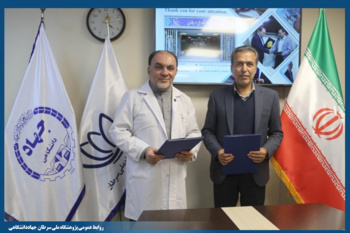
According to a report by the Public Relations Office of the Network, during a meeting attended by the Head of the Iranian Materials and Energy Research Center and the President of the INN, the Secretary and Deputy for Executive Governance of the INN, the Head of the Health Technology Incubator of Iran University of Medical Sciences, the Head of the Stem Cells Department of the Islamic World Nanotechnology Network, the Head of the Regenerative Medicine Department of the Islamic World Nanotechnology Network, the President of the ACECR National Cancer Institute, and a number of managers and faculty members of the institute, the official membership document of the ACECR National Cancer Institute in the INN was signed.
Dr. Mohammad Reza Rahimi-Pour, President of the Inter-Islamic Network on Nanotechnology (INN), referring to shared capacities, stated: At the Materials and Energy Research Center, specialized groups are active in the fields of biomaterials, cell culture, biological scaffolds, surface engineering, nanomaterials, and sensors, many of which overlap with the needs and programs of the National Cancer Institute. Also, existing capacities in additive manufacturing and 3D printing can provide the basis for joint cooperation.
He also proposed the formation of an international research consortium in the field of cancer with the participation of universities and scientific centers of member countries, including Turkey, Malaysia, Pakistan, and Egypt, and added: With the scientific leadership of the National Cancer Institute, the research capacities of these countries can be organized within the framework of joint projects, and the ground can be provided for using mutual capabilities.
In continuation of the meeting, Dr. Ali Karimi Morid, Deputy for Executive Governance of the Inter-Islamic Network on Nanotechnology, explained the position and missions of the network and stated: The nature of the network’s activity is to create communication and synergy among the scientific, research, and technological capacities of member countries. He added: The fundamental difference between this network and many entities that merely carry an international title is that it was formed from the beginning within the framework of an intergovernmental organization and with the backing of cooperation among member countries; this can facilitate confidence-building and the development of cross-border cooperation.
Dr. Karimi Morid also added: The network operates in five main areas: education, development of research cooperation, scientific activities and publication of journals, holding international conferences and events, and commercialization of products and technological achievements. Our goal is to identify the existing capacities in universities, research institutes, incubators, and knowledge-based companies of Islamic countries and connect them to one another through a common platform.
Referring to the capacities of the National Cancer Institute in the field of diagnosis and technological treatment of cancer, he said: This institution has valuable capabilities in the fields of technology, product production, research activities, and possessing specialized faculty members. We will try to introduce these capacities to member countries within the network’s platform and provide the ground for defining joint projects, attracting research grants, developing educational cooperation, and creating commercial opportunities.
In continuation, Dr. Sarami-Foroushani, President of the ACECR National Cancer Institute, stated that alongside treatment activities, this institution pursues the development of modern technologies as one of its main missions, and added: In our view, research is valuable when it can lead to solving a real problem and its result is ultimately visible in the patient’s life and in improving cancer diagnosis and treatment processes. Producing papers and scientific achievements is necessary, but by itself it is not sufficient for fulfilling the institute’s missions.
Referring to the institute’s research st ructure, he also stated: One of the important features of this institution is the formation of cooperation among specialists from different disciplines, including medicine, engineering, chemistry, and biotechnology, which has made it possible to develop interdisciplinary approaches and move toward technological treatments.
At the end of the meeting, the official membership document of the ACECR National Cancer Institute in the Inter-Islamic Network on Nanotechnology (INN) was signed. This membership provides the ground for the institute’s official presence within the network’s scientific and technological cooperation framework and for pursuing joint programs in the fields of nanotechnology, nanomedicine, and modern technologies for cancer diagnosis and treatment.
Notably, the INN Network is an international platform for leveraging the power of science and technology to support inclusive empowerment. The Network strives to provide a dynamic platform for countries to achieve growth, progress, and a knowledge-based economy by fostering collaboration between elites, professors, researchers, universities, research institutes, and knowledge-based companies.
This international platform is one of the thirteen scientific networks affiliated with COMSTECH, and it is hosted by the MERC under the MSRT of Iran.

Your Comment :